Vitamin C & Sport
Physical exertion · Oxidative stress · High doses
Scientific data · Studies cited · Limitations and precautions
Physical exercise is one of the most powerful sources of endogenous oxidative stress. During intense exertion, oxygen consumption can increase 10- to 15-fold compared with rest, mechanically generating a massive flow of reactive oxygen species (ROS). Vitamin C, the body's main water-soluble antioxidant, lies at the heart of a question asked by researchers and athletes alike: does it help performance or hinder it?
The answers are nuanced, and the available data reveal a fascinating picture in which dose, context and sporting profile all play a decisive role.
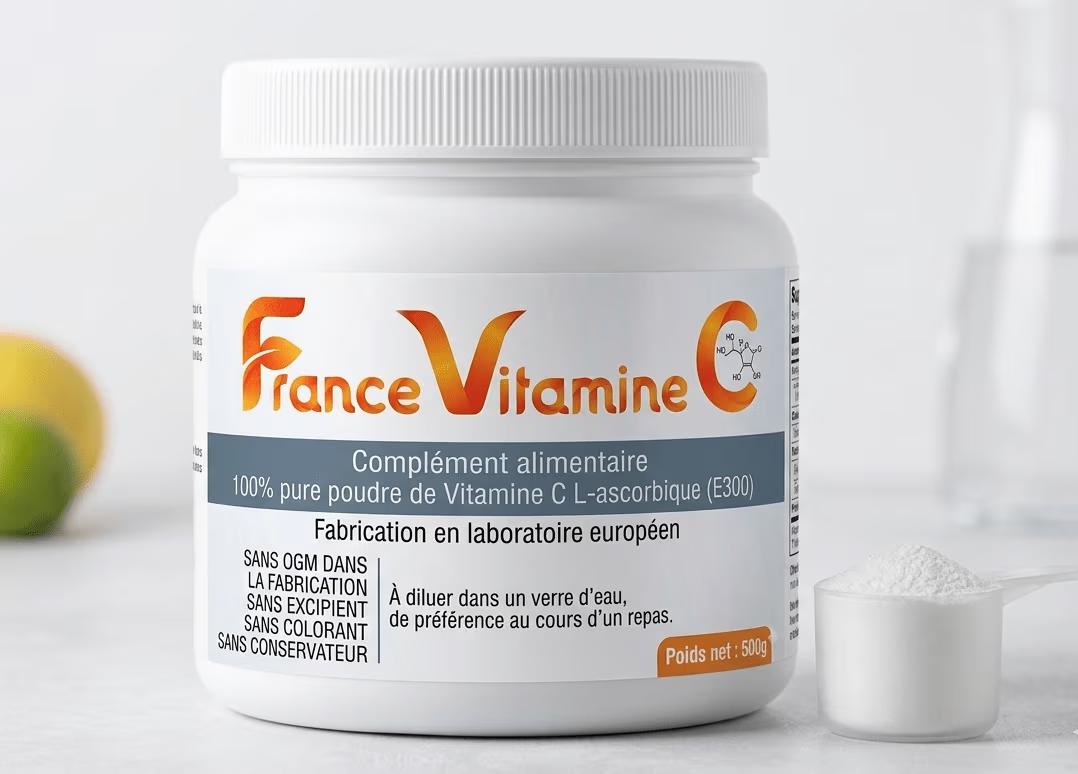
To find out more about our forms of vitamin C, see the page on calcium ascorbate, a mineral salt of ascorbic acid. Always follow the dose stated on the label (1,000 mg of vitamin C per day at most).
Why does intense exercise generate oxidative stress?
Three mechanisms combine during exertion: the mitochondrial respiratory chain produces superoxide anions, the ischaemia-reperfusion of contractions generates hydroxyl radicals, and activated neutrophils release oxidants.
During intense physical activity, several mechanisms simultaneously generate free radicals:
- The mitochondrial respiratory chain produces superoxide anions (O₂•⁻) as unavoidable by-products of ATP production
- Ischaemia-reperfusion during muscle contractions generates hydroxyl radicals (OH•) through the Fenton reaction
- Neutrophils activated by muscle inflammation release hydrogen peroxide (H₂O₂) through their bactericidal activity
- Muscle xanthine oxidase is activated by local hypoxia during intense contractions
These ROS can damage cell membranes (lipid peroxidation), contractile proteins and mitochondrial DNA when they are not neutralised by the body's antioxidant systems. This mechanism is among the hypotheses put forward to explain delayed-onset muscle soreness (DOMS).
What do studies show about vitamin C and recovery after exercise?
The results vary: some blood markers of oxidative stress decrease after intense exercise in supplemented subjects, but this decrease proves neither better recovery nor better performance.
Intense exertion is accompanied by increased production of reactive oxygen species, measured using markers such as malondialdehyde (MDA), a biomarker of lipid peroxidation. Several studies have sought to determine whether additional vitamin C intake alters these markers. The results depend on the dose, the type of exertion and the participants' baseline status, and a decrease in a marker does not, on its own, mean improved recovery.
The study by Peters et al. (1993), conducted in ultramarathon runners, is one of the most widely cited: the authors reported fewer self-reported symptoms of upper respiratory tract infection after the race in the group given vitamin C than in the placebo group. This is an old study, in a very specific population. The European Food Safety Authority (EFSA) has not authorised any claim relating to the prevention of infections or to a reduction in their frequency.
📚 Reference: Peters EM et al. Vitamin C supplementation reduces the incidence of postrace symptoms of upper-respiratory-tract infection in ultramarathon runners. Am J Clin Nutr. 1993;57(2):170–174. doi: 10.1093/ajcn/57.2.170
Literature reviews describe a so-called “bell-shaped” relationship (hormesis): low levels of reactive species are useful signals for adaptation, whereas high levels are harmful. The effect of an antioxidant therefore depends on the dose and the context (Radak et al., 2017, reference below).
In the European Union, the only authorised claim on this subject is as follows: “Vitamin C contributes to maintain the normal function of the immune system during and after intense physical exercise”. The beneficial effect is obtained with a daily intake of 200 mg in addition to the recommended daily intake of vitamin C.
📚 Reference: Radak Z et al. Exercise, Oxidants, and Antioxidants Change the Shape of the Bell-Shaped Hormesis Curve. Redox Biology. 2017;12:285–290. doi: 10.1016/j.redox.2017.02.015
Do high doses of antioxidants hold back progress?
This is the paradox highlighted by Paulsen et al. (2014, Journal of Physiology): 1,000 mg of vitamin C combined with 235 mg of vitamin E held back certain cellular adaptations to endurance training.
This is one of the most counter-intuitive findings of modern sports science. A rigorous clinical trial published in the Journal of Physiology by Paulsen et al. (2014) showed that high doses of vitamin C (1,000 mg/day), combined with vitamin E (235 mg/day), held back certain cellular adaptations to endurance training.
In practical terms, the researchers observed that:
- High-dose antioxidants blunted the increase in mitochondrial proteins (PGC-1α, cytochrome C) needed to improve muscular endurance
- Mitochondrial biogenesis — the process by which training creates new mitochondria in the muscles — was reduced in the supplemented group
- VO₂max was not directly affected, but the number of mitochondria per muscle fibre increased significantly less over 11 weeks of training
The hypothesis put forward to explain this result is as follows: the free radicals produced by exercise are not just “waste”; they also act as cell signals (notably via AMPK and PGC-1α) that trigger the body's adaptations to training. Neutralising them massively could amount to “switching off the alarm signal” that triggers repair and adaptation. This dose of 1,000 mg/day corresponds to the maximum daily dose of our products: do not exceed it.
📚 Reference: Paulsen G et al. Vitamin C and E supplementation hampers cellular adaptation to endurance training in humans: a double-blind, randomised, controlled trial. J Physiol. 2014;592(8):1887–1901. doi: 10.1113/jphysiol.2013.267419
What is known about vitamin C deficiency in athletes?
A deficiency (plasma concentration below 23 µmol/L, the commonly used deficiency threshold) is a state of insufficiency that adequate dietary intake makes it possible to avoid. Athletes, like all adults, have every reason to meet their needs.
While an excess of antioxidants can be counter-productive under certain experimental conditions, a proven deficiency is clearly unfavourable: its extreme form is scurvy. Vitamin C contributes to the reduction of tiredness and fatigue (authorised claim), and a diet rich in fresh fruit and vegetables remains the primary source of intake.
The data cited in this article therefore call for caution in both directions: neither deficiency nor excess. None of the studies mentioned here makes it possible to recommend a particular dose for an athlete.
Which doses have been studied for each type of exertion?
The studies cited most often use 200 to 500 mg per day. These are doses that have been studied, not recommendations: the daily dose of our products does not exceed 1,000 mg.
| Sporting profile | Question studied | Dose studied | Remark |
|---|---|---|---|
| Endurance athlete (marathon, triathlon) | Respiratory symptoms after exertion, oxidative stress markers | 200–500 mg/day | 1,000 mg/day combined with vitamin E held back certain adaptations to training (Paulsen et al. 2014) |
| Strength athlete (bodybuilding, weightlifting) | Muscle soreness (DOMS), collagen synthesis in tendons and ligaments | 200–500 mg/day | Results vary between studies |
| Team sports (football, rugby, basketball) | Respiratory symptoms, recovery between matches | 200–500 mg/day | Limited data |
| Plasma status below 23 µmol/L (deficiency) | Restoring vitamin C status | To be determined with a healthcare professional | A deficiency requires medical advice |
| Ultra-endurance (trail running, Ironman) | Respiratory symptoms after the race | See the study cited (Peters et al. 1993) | Fewer symptoms reported in the supplemented group; old study, specific population |
How is intake organised in the studies?
In most studies, vitamin C is taken in the morning, on an empty stomach or with breakfast. As a precaution, some authors suggest avoiding the peri-exercise window (one hour before and after exertion) so as not to mask the redox signals that trigger muscle adaptations.
The question of timing is often overlooked. The available data allow a few points to be noted, which remain research hypotheses rather than recommendations:
- Around exercise (−1 h / +1 h): some authors suggest refraining, so as not to mask the redox signals that trigger muscle adaptations
- In the morning, on an empty stomach or with breakfast, is the most common timing in the studies
- Outside periods of intense training (rest days, off-season): the risk of interfering with muscle adaptation described by Paulsen et al. is assumed to be lower, but data are limited
- Splitting the dose: intestinal absorption of vitamin C is saturable (SVCT1 transporter), which explains why high doses are often split in the studies. Never exceed the daily dose stated on the label (1,000 mg at most)
What role for tendons, ligaments and cartilage?
A structural role: vitamin C is the essential cofactor of prolyl and lysyl hydroxylases, the enzymes that stabilise the collagen triple helix. Without it, the collagen produced is structurally fragile.
Beyond oxidative stress, vitamin C is involved in tissue structure: it is the essential cofactor of prolyl and lysyl hydroxylases, the enzymes that stabilise the collagen triple helix in tendons, ligaments and cartilage. Without vitamin C, the collagen produced is structurally fragile. Vitamin C contributes to normal collagen formation for the normal function of bones and cartilage (authorised claim).
Shaw et al. (2017, American Journal of Clinical Nutrition) studied the intake of vitamin C-enriched gelatin (48 mg) one hour before a jumping exercise and reported an increase in a marker of collagen synthesis. This is a small study, which does not allow any conclusion to be drawn about an effect on tendon health.
📚 Reference: Shaw G et al. Vitamin C–enriched gelatin supplementation before intermittent activity augments collagen synthesis. Am J Clin Nutr. 2017;105(1):136–143. doi: 10.3945/ajcn.116.138594
What are the key points on doses when you play sport?
The studies cited most often use 200 to 500 mg per day, which is less than the maximum daily dose of our products (1,000 mg). Do not exceed the dose stated on the label; if in doubt, ask a healthcare professional for advice.
Research on vitamin C and sport leads to a cautious conclusion: neither deficiency nor excess. In the trial by Paulsen et al. (2014), 1,000 mg/day of vitamin C combined with vitamin E held back certain adaptations to endurance training. Doses above 1,000 mg/day exceed the daily dose of our products: do not exceed them.
For reference, the European nutrient reference value (NRV) is 80 mg of vitamin C per day, and the authorised claim for intense physical exercise refers to an intake of 200 mg in addition to the recommended daily intake. A diet rich in fresh fruit and vegetables remains the primary source of vitamin C.