
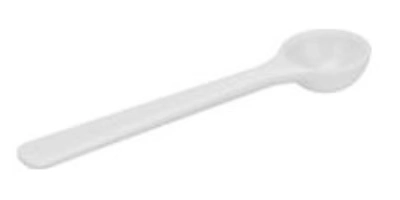
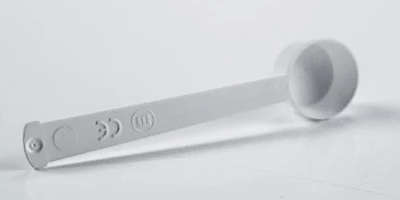
Dosing spoon for powder — 1 ml and 2 ml
Calibrated, repeatable dosing — 1 ml ≈ 0.5 g · 2 ml ≈ 1 g
In brief
- What is it?
- A food-grade plastic measuring spoon, calibrated by volume, for taking a consistent amount of powder without scales.
- Capacities and prices
- 1 ml ≈ 0.5 g of powder — €1.00 · 2 ml ≈ 1 g of powder — €1.00.
- Vitamin C equivalent
- With pure L(+) ascorbic acid, one level 2 ml spoon delivers about 1,000 mg of vitamin C; the 1 ml spoon about 500 mg.
- Why not a teaspoon?
- A kitchen teaspoon holds anywhere from 3 to 7 ml depending on the model and how it is filled: the dosing error can exceed 100%.
The dosing spoon lets you take a consistent amount of powder without scales. Two capacities are available:
- 1 ml ≈ 0.5 g of powder — to fine-tune a serving or split a dose
- 2 ml ≈ 1 g of powder — the reference serving for a daily vitamin C intake
With pure L(+) ascorbic acid, one level 2 ml spoon delivers about 1,000 mg of vitamin C. It is the most practical everyday measure: one level spoon = one dose.
A kitchen teaspoon, by contrast, holds anywhere from 3 to 7 ml depending on the model — and on who fills it. The dosing error can exceed 100%. A calibrated dosing spoon removes that variability: it is the difference between "roughly" and a dose that is the same from one day to the next.
- 📏 Calibrated volume — 1 ml or 2 ml, level
- 🥣 Food-grade white plastic
- 🔁 Reusable and washable
- 🫙 Fits through the 80 mm opening of our PE plastic jars
Which spoon for which use?
- 2 ml — the most versatile: 1 g of powder, the reference serving for pure vitamin C
- 1 ml — for split servings through the day, smaller doses, or very concentrated fruit powders
- Both — one dedicated spoon per jar avoids carrying one powder into another
How to use
Dip the spoon into a dry powder, fill it, then level it off with the back of a knife or the rim of the jar. Do not compact.
A heaped spoon can hold 30 to 50% more than a level one: always level off to get a dose that is repeatable from one day to the next.
Conversion table
| Amount taken | Volume | Powder (≈) | Pure vitamin C (≈) |
|---|---|---|---|
| 1 × 1 ml spoon | 1 ml | 0.5 g | 500 mg |
| 1 × 2 ml spoon | 2 ml | 1 g | 1,000 mg |
| 2 × 2 ml spoons | 4 ml | 2 g | 2,000 mg |
Indicative values based on a density of about 0.5 g/ml. The "pure vitamin C" column applies only to 100% L-ascorbic acid: with a fruit powder (acerola, camu-camu, sea buckthorn) the content is markedly lower.
For reference: the dietary reference intake for vitamin C is 110 mg/day (ANSES 2021) and the EFSA tolerable upper intake level is 2,000 mg/day from all sources combined.
Care
Wash by hand in lukewarm water with mild soap, then dry completely. Never put a damp spoon back into a powder: moisture makes the powder clump and speeds up the oxidation of vitamin C. Ideally, keep the spoon clean, dry and outside the jar.
Technical specifications
| Specification | 1 ml spoon | 2 ml spoon |
|---|---|---|
| Level volume | 1 ml | 2 ml |
| Powder equivalent | ≈ 0.5 g | ≈ 1 g |
| Pure vitamin C equivalent | ≈ 500 mg | ≈ 1,000 mg |
| Material | food-grade plastic | food-grade plastic |
| Colour | white | white |
| Reusable | yes | yes |
| Care | hand wash, lukewarm water | hand wash, lukewarm water |
| Price incl. VAT | €1.00 | €1.00 |
The gram equivalents are orders of magnitude: a spoon measures a volume, and the mass depends on the density of your powder.
What you buy. Nothing more.
One dosing spoon, sold individually. A calibrated level volume, not an approximate marking.
A dosing spoon measures a volume. The mass depends on the density of your powder: the gram equivalents are orders of magnitude.
Identified manufacturer. Documented supply chain.
Food-grade plastic. Declaration of compliance on request.