
A serious technology, thin evidence
Absorption · Strength of evidence · Tolerance · Extra cost
The short answer: liposomal vitamin C reaches slightly higher plasma concentrations than the standard form at high doses, in a small number of studies. It is easier on the stomach. But the strength of the evidence remains low, and the extra cost is substantial — on the order of three to five times the price per gram of vitamin C.
This is a product we sell, and we would rather be straight with you: in most situations, splitting a standard powder into several servings gives a comparable result for far less money.
How Does Liposomal Vitamin C Actually Work?
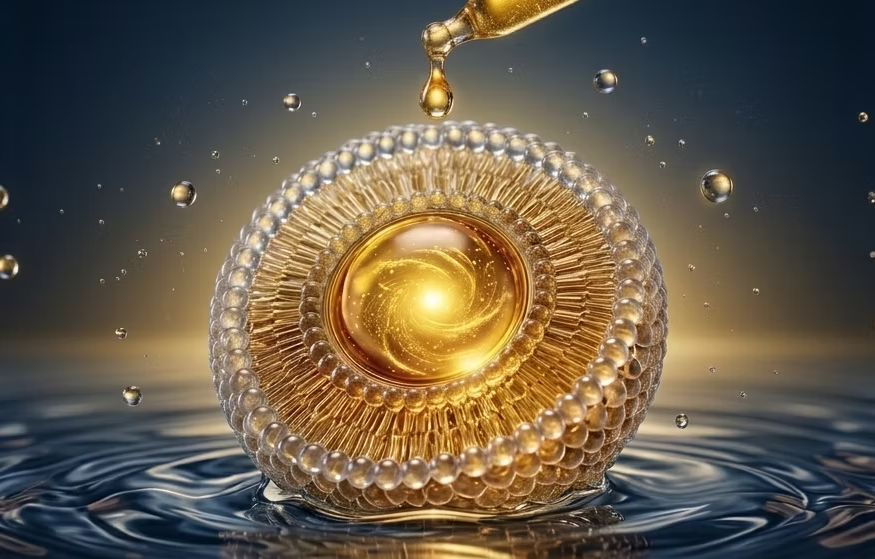
The vitamin C is enclosed in tiny phospholipid vesicles. These liposomes, made from the same family of molecules as our cell membranes, protect the vitamin as it passes through the stomach and intestine.
The theoretical appeal rests on a very real bottleneck: the SVCT1 transporters in the intestine saturate. Above roughly 200 mg per serving, a growing share of the dose is simply not absorbed. Liposomal encapsulation aims to bypass that saturation by taking a different absorption route, passive rather than carrier-mediated.
The logic is sound. The question is whether it holds up in humans, and by how much.
What Do the Absorption Studies Really Show?
A genuine but modest advantage, measured in very few participants. The most-cited study involved eleven people. That is the single most important point in this article.
Davis and colleagues (2016, Nutrition and Metabolic Insights) compared 4 g of liposomal vitamin C with 4 g of standard vitamin C in eleven volunteers. The liposomal form produced higher plasma concentrations — but the gap, though statistically measurable, remains modest, and eleven participants support no firm conclusion.
| What is established | What is not |
|---|---|
| Liposomal technology exists and can be characterised in the laboratory | A clinical benefit — fewer colds, more energy — has never been demonstrated |
| At high doses, plasma levels rise somewhat higher | The true size of the gap, for want of adequately sized studies |
| Digestive tolerance is better | That every product on the market labelled "liposomal" contains real liposomes |
One point that should put any buyer on alert: the word "liposomal" is not protected. Many products sold under that name mostly contain lecithin mixed with vitamin C, with no verified liposomal structure.
Does Liposomal Really Get Past the Saturation Point?
Partly, and only at high doses. Below 200 mg per serving, there is nothing to bypass: the standard form is already absorbed at close to 100%.
Levine's work (1996, PNAS) remains the reference on this point. Absorption of ascorbic acid is near complete at ordinary doses, then declines: around 73% at 500 mg, under 50% at 1,250 mg. It is only in that upper range that encapsulation can make a difference.
Put another way: if you take 500 mg a day, liposomal will most likely give you nothing measurable. If you are aiming for 3 or 4 g a day, the question becomes a serious one.
Is It Easier on the Stomach?
Yes, and that is its most tangible advantage. The phospholipids shield the vitamin C from the gastric wall, which markedly reduces burning and discomfort.
That benefit needs no sophisticated study to be observed. It is, however, shared with a far cheaper form: calcium ascorbate, whose near-neutral pH solves the same problem for a fraction of the price.
If acidity is your only difficulty, the buffered form is the rational choice. Liposomal earns its place when you want both tolerance and a high dose.
What Does a Gram of Liposomal Vitamin C Really Cost?
Roughly three to five times the price of the standard powder, vitamin C for vitamin C. The calculation is worth doing before you buy, because labels state powder weights, not amounts of vitamin C.
| Product | Size | Price | Indicative cost per gram of vitamin C |
|---|---|---|---|
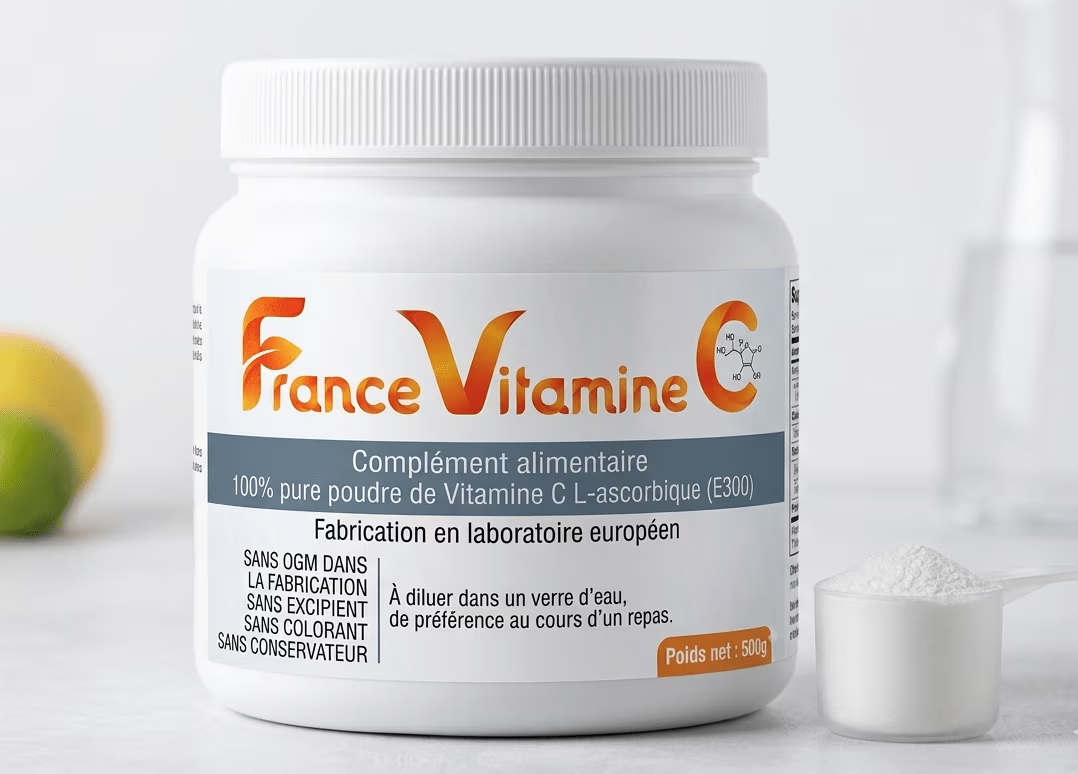
| Pure L-ascorbic acid | 1 kg — €69.00 | €69.00 | ≈ €0.07 |
| Pure L-ascorbic acid | 500 g — €39.00 | €39.00 | ≈ €0.08 |
| Liposomal vitamin C | 500 g — €129.00 | €129.00 | several times higher |
There is a reason for the premium: encapsulation is a genuine industrial process, not a marketing line. The question is not whether it is justified for the manufacturer, but whether it is for you, given the strength of the evidence.
When Is Liposomal Worth the Money?
In three situations, no more. Outside them, standard powder split into several servings remains the best ratio of effect to spend.
- You are aiming for high doses, beyond 2 g a day, and you want to limit the unabsorbed share.
- You cannot tolerate the acidity and calcium ascorbate does not suit you, for instance if you are watching your calcium intake.
- You have a sensitive gut: unabsorbed vitamin C stays in the intestine and can have a laxative effect. Reducing that fraction improves comfort.
In every other case — and they are the majority — splitting 1 g of standard powder into two or three servings does the job, at a tenth of the price.
So Which One Should You Choose?
Start with the standard form, split across the day. Move to liposomal only if a specific reason calls for it, not because the word sounds modern.
| Your situation | Our recommendation |
|---|---|
| Daily intake of 200 to 1,000 mg | Pure L-ascorbic acid, in 2 servings |
| Sensitive stomach, moderate dose | Calcium ascorbate |
| High doses, more than 2 g a day | Liposomal, or standard split into many servings |
| Gut sensitive to high doses | Liposomal |
| Tight budget | Pure L-ascorbic acid, without hesitation |
We sell all three forms. We would rather you chose the right one than the most expensive one.
Three forms, from the simplest to the most engineered
Pure powder for dose per euro, calcium ascorbate for tolerance, liposomal for high doses.
FAQ
Sources : Davis JL, Paris HL, Beals JW, et al. (2016). Liposomal-encapsulated ascorbic acid: influence on vitamin C bioavailability and capacity to protect against ischemia-reperfusion injury. Nutr Metab Insights, 9:25-30. | Levine M, Conry-Cantilena C, Wang Y, et al. (1996). Vitamin C pharmacokinetics in healthy volunteers. PNAS, 93(8):3704-3709. | Łukawski M, Dałek P, Borowik T, et al. (2020). New oral liposomal vitamin C formulation: properties and bioavailability. J Liposome Res, 30(3):227-234. | Padayatty SJ, Levine M. (2016). Vitamin C: the known and the unknown and Goldilocks. Oral Dis, 22(6):463-493. | EFSA Panel on Dietetic Products, Nutrition and Allergies (2013). Scientific Opinion on Dietary Reference Values for vitamin C. EFSA Journal, 11(11):3418.