Vitamin C is one of the most fragile vitamins. Water-soluble, heat-sensitive and light-sensitive, it can largely be destroyed before it even reaches your plate. Understanding these losses is essential to optimizing your daily nutritional intake.
Why is vitamin C so easily destroyed?
Six factors break it down: heat from 60°C upward, oxygen, light, water (it is water-soluble and leaches out), copper and iron, and an alkaline pH. Each one lowers the vitamin C that actually reaches your plate.
L-ascorbic acid is an organic molecule that degrades easily under the action of several factors:
- Heat: degradation begins at 60°C and accelerates exponentially
- Oxygen: oxidation destroys vitamin C upon contact with air
- Light: UV rays cause rapid photo-degradation
- Water: being water-soluble, it passes into cooking water
- Metals: copper and iron catalyze its destruction
- Alkaline pH: a basic environment (baking soda) destroys it quickly
How much vitamin C is lost during storage?
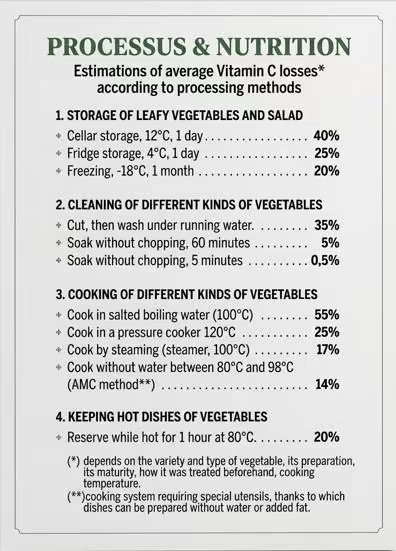
Between 10% and 80%, depending on the method. Vegetables left at room temperature for three days lose 40 to 60%, the fridge holds that to 10 to 20% over the same period, and drying costs 50 to 80%.
Even before cooking, food storage leads to significant losses:
| Storage method | Duration | Vitamin C loss |
|---|---|---|
| Vegetables at room temperature | 24 hours | 15 to 25% |
| Vegetables at room temperature | 3 days | 40 to 60% |
| Refrigerator (4°C) | 3 days | 10 to 20% |
| Refrigerator (4°C) | 7 days | 25 to 50% |
| Freezing (-18°C) | 3 months | 20 to 40% |
| Drying / dehydration | — | 50 to 80% |
💡 Practical tip: Consume your fruits and vegetables fresh quickly after purchase, ideally within 24-48 hours. Store them in the refrigerator in airtight bags to minimize losses.
Which cooking method destroys the least vitamin C?
Short steaming: 15 to 25% loss over 5 minutes, against 55 to 75% for cut vegetables boiled in water and 60 to 80% for deep frying. Cooking is by far the most destructive step of all.
Cooking is the most destructive factor. Losses vary considerably depending on the method:
| Cooking method | Temperature | Vitamin C loss |
|---|---|---|
| Raw / no cooking | — | 0% |
| Steam (short) | 100°C, 5 min | 15 to 25% |
| Steam (long) | 100°C, 20 min | 30 to 45% |
| Boiling water (whole vegetables) | 100°C, 10 min | 40 to 55% |
| Boiling water (cut vegetables) | 100°C, 10 min | 55 to 75% |
| Microwave | Variable | 20 to 30% |
| Deep frying | 170-180°C | 60 to 80% |
| Roasting in oven | 200°C, 30 min | 60 to 85% |
| Pressure cooker | 120°C | 50 to 70% |
Does cutting and peeling reduce vitamin C?
Yes. Fine cutting can double the losses compared with whole vegetables, because it multiplies the surface exposed to air and water. Peeling removes the outer layers, where vitamin C is often concentrated.
Cutting fruits and vegetables multiplies the contact surface with air and water, accelerating oxidation and losses in cooking water. The smaller the pieces, the greater the losses.
- Peeling removes the outer layers where vitamin C is often concentrated
- Fine cutting can double losses compared to whole vegetables
- Preparing salads in advance leads to progressive oxidation
What happens to vitamin C in cooking water?
It leaches out: INRAE work shows up to 40% of the vitamin C ends up in the cooking liquid. Keep that water for broths, soups or sauces, or steam for 5 to 8 minutes and skip the leaching.
When you cook vegetables in water, vitamin C — being water-soluble — passes into the cooking liquid. Studies from INRAE show that:
- Up to 40% of vitamin C ends up in the cooking water
- This cooking water can be reused for broths, soups or sauces
- Steam cooking avoids this leaching phenomenon
🏆 Optimal cooking method: Short steam cooking (5-8 minutes maximum) is the best compromise between palatability and vitamin C preservation. It limits losses to 15-25% while ensuring satisfactory cooking.
Which foods contain the most vitamin C?
Per 100 g raw: acerola powder 17,000 to 25,000 mg, camu-camu powder 12,000 to 20,000 mg, sea buckthorn powder 2,500 to 4,000 mg, raw red pepper 190 mg and fresh parsley 130 mg. Steamed, the pepper drops to 90 to 110 mg.
For reference, here is the vitamin C content of some common foods in their raw state:
| Food | Vitamin C per 100g | After cooking (estimate) |
|---|---|---|
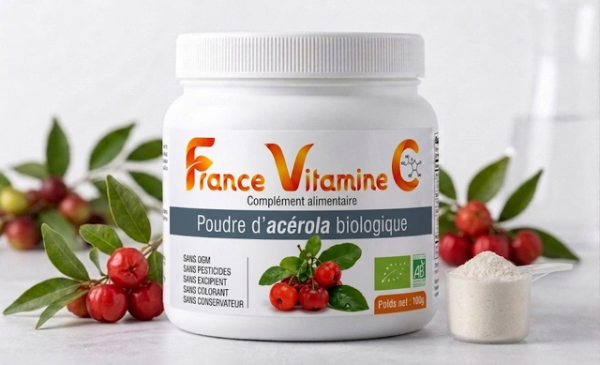
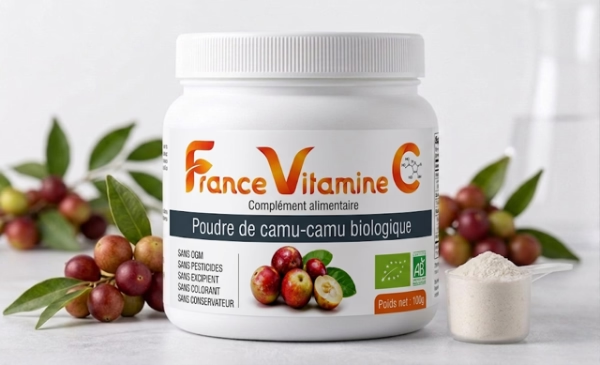
| Camu-camu (FVC Organic powder) | 12,000 – 20,000 mg | Not applicable (powder) |
| Acerola (FVC Organic powder) | 17,000 – 25,000 mg | Not applicable (powder) |
| Sea Buckthorn (FVC Organic powder) | 2,500 – 4,000 mg | Not applicable (powder) |
| Raw red pepper | 190 mg | 90–110 mg (steamed) |
| Fresh parsley | 130 mg | Not applicable (raw) |
| Raw green pepper | 120 mg | 60–75 mg (steamed) |
| Kiwi | 80 mg | Not applicable (raw) |
| Orange | 50 mg | Not applicable (raw) |
| Lemon | 46 mg | Not applicable (raw) |
| Steamed broccoli | 65 mg (raw) | 45–50 mg (steamed 8 min) |
| Boiled potato | 20 mg (raw) | 8–12 mg (boiled) |
Does food alone still cover your vitamin C needs?
Often less well than composition tables suggest, because cooking and long storage cut the real content. The French reference intake is 110 mg/day (ANSES 2021), while some researchers consider 500 mg to 2 g optimal.
Given this data, it is clear that the modern diet, particularly with its high-temperature cooking methods and long storage times, often provides far less vitamin C than nutritional composition tables suggest.
The recommended daily intake in France is 110 mg per day (ANSES 2021), but many researchers and doctors consider that higher intakes (500 mg to 2g) are optimal for prevention and health maintenance.
Supplementation in the form of pure vitamin C powder, organic superfruit powders or liposomal powder guarantees consistent intake, without the vagaries of cooking and storage.