95% of the world's vitamin C is produced in China. Here's a factual comparison.
Where is the world's vitamin C actually made?
China produces about 95% of the roughly 150,000 tonnes made each year. One major producer remains in Europe, DSM (dsm-firmenich), whose Quali-C brand is the last European source.
Global production: ~150,000 tonnes/year. China: 95% of production.
In Europe, one major producer remains: DSM (dsm-firmenich). Its Quali-C brand is the last European bastion.
How do Chinese and European vitamin C compare?
On five criteria: purity (97 to 99% vs 99.7% or more), reference standard (internal or BP/CP vs Ph. Eur.), GMP (variable vs EU GMP inspected by the EMA), heavy metals (under 0.5 ppm lead per ICH Q3D) and raw material (often GMO corn vs certified non-GMO).
| Criterion | China origin (typical) | Europe origin (DSM) |
|---|---|---|
| Purity | 97–99% | ≥99,7% |
| Reference standard | BP/CP or internal standard | European Pharmacopoeia (Ph. Eur.) |
| GMP Certification | Variable (China GMP) | EU GMP (EMA inspected) |
| Heavy metals control | Per applied standard | <0.5 ppm Pb (ICH Q3D) |
| Residual solvents | Not always tested | Controlled (ICH Q3C) |
| Raw material | Corn (often GMO) | Certified non-GMO |
| Traceability | Multi-intermediary | Direct manufacturer to distributor |
| Auditability | Complex (distance, language) | Standard European audit |
Is the manufacturing process actually different?
Both routes use the modified Reichstein process, so the difference lies in production conditions. DSM runs a two-step fermentation with multiple crystallisation stages, holding purity consistently above 99.7%.
Both use the modified Reichstein process. Difference lies in production conditions.
DSM: two-step fermentation, multiple crystallization. Purity consistently >99.7%.
Do the pharmacopoeias set the same requirements?
Not exactly. For the assay of ascorbic acid, the European Pharmacopoeia and the USP use the same range, from 99.0% to 100.5%. The difference lies in the impurities controlled, the methods required and the inspection of production sites.
Several pharmacopoeias exist worldwide: European (Ph. Eur.), American (USP), British (BP) and Chinese (ChP). For the assay of ascorbic acid, the Ph. Eur. (monograph 0253) and the USP use the same range, from 99.0% to 100.5%. The gaps between standards therefore lie less in the stated purity than in the list of impurities controlled, the analytical methods required and the inspection regime applied to production sites.
Chinese manufacturers can produce Ph. Eur. compliant acid. But most target less demanding markets.
How many intermediaries are in the supply chain?
Typically 3 to 5 in the Chinese chain, which makes the origin harder to trace. Direct European sourcing runs on 1 or 2 links, with a manufacturer that is identified and can be audited.
Chinese chain: often 3-5 intermediaries. Potential opacity.
Direct European sourcing: 1-2 links. Identified and auditable manufacturer.
Why does European vitamin C cost more?
European vitamin C costs 2 to 4 times more than the usual grades. Measured where it actually matters, on a single daily dose, that gap comes down to a few cents.
European vitamin C: 2-4x more expensive. Extra cost: a few cents per daily dose.
What questions should you ask your vitamin C supplier?
Five questions are enough to tell a transparent supplier from a reseller who does not know where its raw material comes from: the exact origin, the monograph applied, the batch certificate of analysis, the measured purity and the number of intermediaries.
| Question to ask | An answer that reassures | What it proves |
|---|---|---|
| What is the exact origin of the raw material? | A manufacturer's name and a production site, not "European Union" or "Asia" | The chain can be traced back to the producer |
| Which monograph applies to this batch? | Ph. Eur., with the monograph number | The batch meets an enforceable standard |
| Can I receive the certificate of analysis for my batch? | Yes, the manufacturer's original certificate | The stated values can be verified |
| What purity was measured on this batch? | A figure, between 99.0% and 100.5% | The grade really is pharmaceutical |
| How many intermediaries stand between you and the manufacturer? | One or two, which the seller can name | The risk of batches being mixed or substituted stays low |
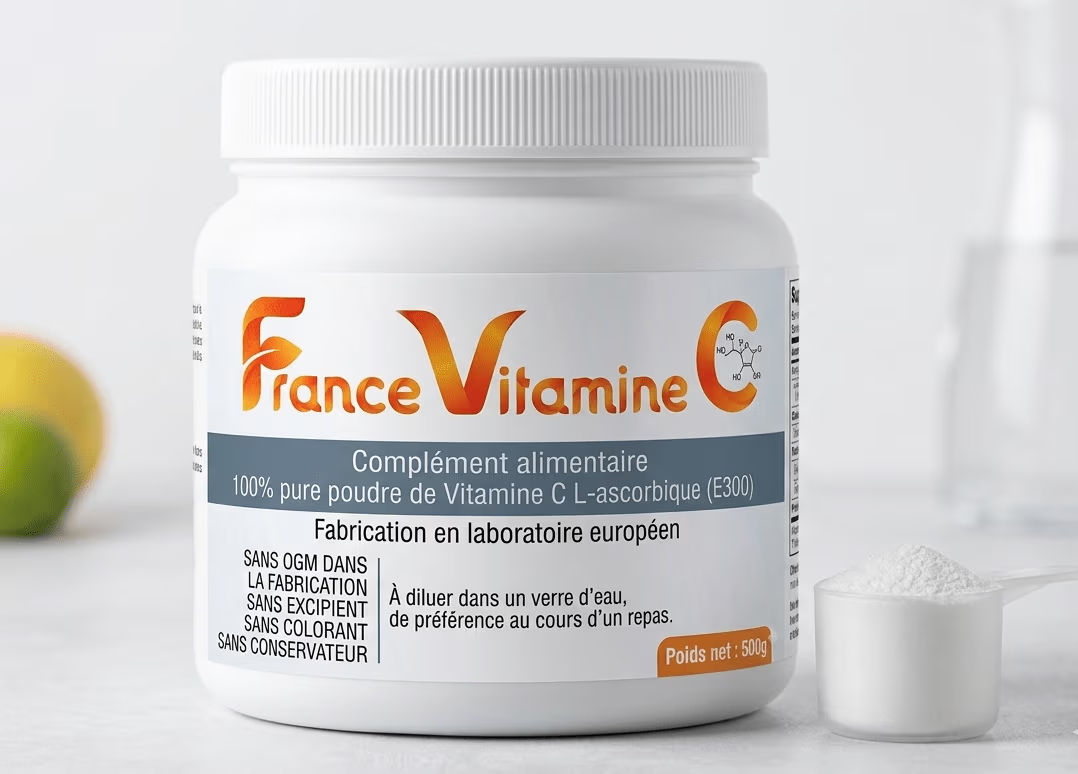
Which vitamin C does France Vitamine C use?
Exclusively European L-ascorbic acid from DSM: Ph. Eur. compliant, certified non-GMO, with direct traceability. The origin of your vitamin C is not a logistics detail, it decides what you swallow every day.
Exclusively European L-ascorbic acid (DSM), Ph. Eur. compliant, non-GMO certified, direct traceability.
The origin of your vitamin C is not a logistical detail. It determines what you put in your body every day.