
Natural or synthetic?
Same molecule · Cofactors · Dosage · Purity
"Natural" or "synthetic"? It is one of the most frequently asked questions about vitamin C. Behind the marketing debate lies a precise chemical reality — and a few nuances that genuinely matter. Here is what the science says, backed by sources.
Worth noting: if it is the acidity of ascorbic acid that bothers you, calcium ascorbate delivers the same vitamin C at neutral pH.
Is natural vitamin C the same molecule as synthetic?
Yes. Vitamin C is a single molecule, L-ascorbic acid (C₆H₈O₆), whether it comes from an acerola cherry or from fermentation. The SVCT1 and SVCT2 transporters cannot tell the two apart.
Vitamin C is a single molecule: L-ascorbic acid, with the formula C₆H₈O₆. Whether this molecule is extracted from an acerola cherry or obtained through industrial fermentation, its structure is rigorously identical. There are not two "types" of vitamin C in chemical terms.
The direct consequence: the body cannot tell the difference. The cellular transporters that absorb vitamin C — the SVCT1 and SVCT2 proteins — recognise the molecular form, not its origin. For an equal amount of L-ascorbic acid, the vitamin activity is therefore the same.
Where does the vitamin C in supplements come from?
Two production routes. Natural powders come from drying and concentrating fruit pulp: acerola, camu-camu, sea buckthorn, rosehip, citrus. Around 95% of world output comes from the Reichstein process or fermentation.
The two families of products differ mainly in their production process:
- Natural sources: some fruits are exceptionally rich in vitamin C — acerola, camu-camu, sea buckthorn, rosehip, citrus fruits. The pulp is dried and then concentrated into a powder.
- Synthesis: around 95% of the world's vitamin C is produced through the Reichstein process or by two-step fermentation from glucose (often derived from corn). The result is a highly pure L-ascorbic acid.
Worth noting: it is this synthetic L-ascorbic acid that has served as the reference in the majority of clinical studies on vitamin C. The efficacy data available to us therefore apply first and foremost to this form.
Is natural vitamin C better absorbed?
No. The benchmark review by Carr and Vissers (2013, Nutrients) concluded that synthetic and food-derived vitamin C are essentially equivalent, confirming what Mangels et al. had already shown in 1993.
This is the most widespread argument — and the most nuanced. The benchmark review on the subject, authored by Carr and Vissers (2013, Nutrients), compared the available human studies. Its conclusion is clear: the bioavailability of synthetic vitamin C and that derived from food are essentially equivalent. The study by Mangels et al. (1993) had already shown that the ascorbic acid from oranges, orange juice and cooked broccoli was absorbed in a manner comparable to synthetic ascorbic acid.
One counterpoint exists: Vinson and Bose (1988) observed that a citrus extract rich in bioflavonoids was absorbed roughly 35% better than ascorbic acid alone. However, this result, obtained on a small sample, has not been consistently reproduced. Carr and Vissers conclude that there is no clinically significant difference for the molecule itself.
📚 Reference: Carr AC, Vissers MCM. Synthetic or food-derived vitamin C — are they equally bioavailable? Nutrients. 2013;5(11):4284-4304. doi: 10.3390/nu5114284
What do natural sources add beyond vitamin C?
A plant matrix: bioflavonoids, polyphenols, anthocyanins and carotenoids, which carry their own antioxidant activity and may act in synergy. Acerola brings bioflavonoids and provitamin A, camu-camu ellagitannins.
While the vitamin C is the same, natural sources provide something the isolated molecule does not: a plant matrix. Around the vitamin C are bioflavonoids, polyphenols, anthocyanins and carotenoids, which have their own antioxidant activity and can act in synergy.
| Natural source | Notable cofactors |
|---|---|
| Acerola | Bioflavonoids, anthocyanins, provitamin A |
| Camu-camu | Polyphenols, ellagitannins, anthocyanins |
| Sea buckthorn | Omega-7, vitamin E, carotenoids, flavonoids |
| Pure L-ascorbic acid | None — vitamin C isolated to ≈99.7% |
This is the entire logic of the "whole-food supplement": you are not consuming vitamin C alone, but a whole range of the fruit's compounds.
Which form makes high doses easy to reach?
Pure L-ascorbic acid, at around 99.7% vitamin C by weight, against roughly 17 to 25% for acerola powder. A natural powder means eating far more material to reach the same intake.
This is where pure L-ascorbic acid regains the advantage. A natural powder contains only a fraction of vitamin C by weight; to reach high intakes, you need to consume more of it.
| Form | Indicative vitamin C content |
|---|---|
| Acerola powder | ≈ 17 to 25% |
| Camu-camu powder | Among the richest (variable content) |
| Sea buckthorn powder | More moderate — benefit = complete profile |
| Pure L-ascorbic acid | ≈ 100% (99.7%) |
For a high, precise and cost-effective intake — for example 1,000 mg — pure L-ascorbic acid is the simplest option: one gram of powder provides around one gram of vitamin C.
How do you judge purity and origin?
A European L-ascorbic acid compliant with the European Pharmacopoeia guarantees purity of 99.7% or more, heavy metals under 0.5 ppm and non-GMO certification. On the natural side, choose certified organic, lab-tested powders.
Whatever the form, it is the manufacturing quality that makes the difference. A European-origin L-ascorbic acid, compliant with the European Pharmacopoeia, guarantees a purity of ≥99.7%, heavy metals <0.5 ppm and non-GMO certification. Conversely, standard grades (often Chinese) are less tightly controlled. On the natural side, favour certified organic powders that have been laboratory-tested. To go further, see our Quality page.
Natural vitamin C or pure ascorbic acid: which one?
There is no universal winner. Natural powders bring cofactors and a whole-food profile; pure L-ascorbic acid gives maximum content, easy precise dosing and the lowest cost per gram of vitamin C.
| Criterion | Natural vitamin C | L-ascorbic acid |
|---|---|---|
| Active molecule | Identical | Identical |
| Cofactors (flavonoids) | ✅ Yes | ❌ No |
| Vitamin C content | Moderate to high | Maximum (≈100%) |
| Precise & high dosing | More difficult | ✅ Very easy |
| Cost per gram of vitamin C | Higher | ✅ Economical |
| Form used in clinical studies | Sometimes | ✅ Predominant |
| "Whole-food" profile | ✅ Yes | ❌ No |
In practice, there is no universal winner, but rather the right choice depending on your goal:
- Daily "whole-food" support, with cofactors → natural vitamin C (acerola, camu-camu, sea buckthorn).
- High, precise and economical intakes → pure L-ascorbic acid.
- The best of both worlds → many people combine a natural source for daily use with pure L-ascorbic acid for targeted intakes.
Which Costs Less per Gram of Vitamin C?
The pure powder costs roughly ten times less per gram of vitamin C. It is the widest gap between the two products, and the one most often overlooked.
| Product | Size | Price | Vitamin C contained | Cost per gram of vitamin C |
|---|---|---|---|---|
| Pure L-ascorbic acid | 1 kg | €69.00 | ≈ 997 g | ≈ €0.07 |
| Pure L-ascorbic acid | 250 g | €24.00 | ≈ 249 g | ≈ €0.10 |
| Organic acerola (25%) | 500 g | €69.00 | ≈ 125 g | ≈ €0.55 |
| Organic acerola (17%) | 500 g | €69.00 | ≈ 85 g | ≈ €0.81 |
There is nothing abnormal about that gap: growing a fruit, drying it and concentrating it costs structurally more than an industrial fermentation. You simply need to know it before comparing two labels on their shelf price.
Which One Is Better Tolerated by the Stomach?
Acerola, gram for gram of powder — but not gram for gram of vitamin C. The acidity comes from the vitamin C itself: at an identical amount of vitamin C, the difference in tolerance narrows sharply.
Pure L-ascorbic acid in solution drops to around pH 2.5. On a sensitive or empty stomach, that can cause burning. There are three fixes, in order of effectiveness:
- Take it with a meal and dilute it in a large glass: enough in most cases.
- Split the dose into two or three servings: better absorption and less acidity at once.
- Switch to calcium ascorbate, whose pH is close to neutral: this is the clearest answer to the acidity problem, with no loss of concentration.
Our matching vitamin C products
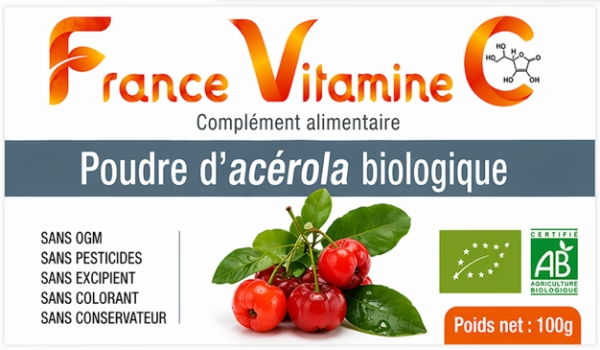
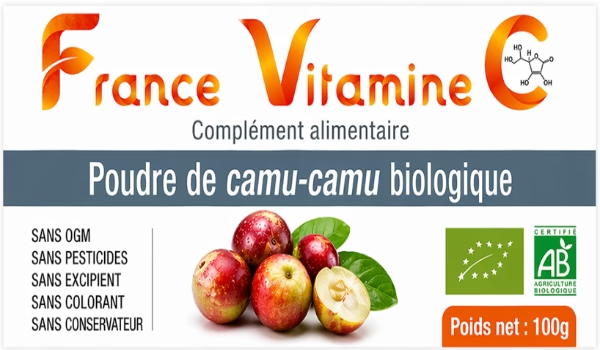
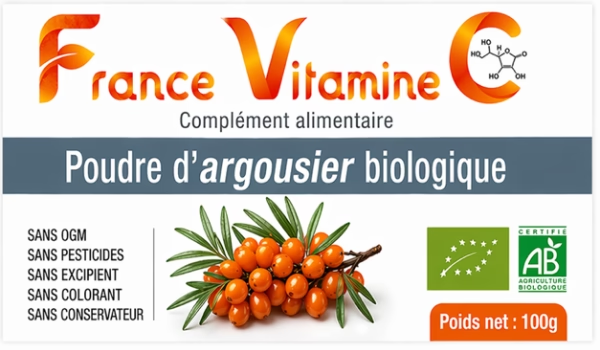
Three certified organic superfruits, rich in natural vitamin C and cofactors.
FAQ
Sources: Carr AC, Vissers MCM. (2013). Synthetic or food-derived vitamin C — are they equally bioavailable? Nutrients. | Mangels AR et al. (1993). J Nutr. | Vinson JA, Bose P. (1988). Am J Clin Nutr. | EFSA (2013). Scientific Opinion on Dietary Reference Values for vitamin C. EFSA Journal. | ANSES (2021).