China accounts for most of the world's vitamin C production. This concentration has direct consequences for quality, traceability and the standards applied. Here is a factual comparison, with no overall value judgement but with verifiable data.
Where is the world's vitamin C actually made?
China accounts for most of the world's production of ascorbic acid, mainly in Hebei and Shandong; almost all of the world's vitamin C is obtained by synthesis or fermentation. According to dsm-firmenich, its site in Dalry (Scotland, United Kingdom) is the only one producing ascorbic acid in the Western world.
Almost all of the world's vitamin C is obtained by synthesis or fermentation. China accounts for most of the world's production, mainly concentrated in the provinces of Hebei and Shandong. The main Chinese manufacturers are CSPC Pharma, Northeast Pharmaceutical and Shandong Luwei.
According to dsm-firmenich, its site in Dalry (Scotland, United Kingdom) is the only one producing ascorbic acid in the Western world.
How do Chinese and European vitamin C compare?
They relate to measurable criteria: purity (from about 97% to over 99.0% depending on the grade, compared with at least 99.7% at dsm-firmenich), standard applied (BP/CP or in-house standard versus Ph. Eur.), GMP certification, heavy metals, residual solvents and traceability.
| Criterion | China origin (according to producers) | dsm-firmenich (Scotland, United Kingdom) |
|---|---|---|
| Purity | Depending on the grade: from about 97% to over 99.0% | ≥99,7% |
| Reference standard | BP/CP or internal standard | European Pharmacopoeia (Ph. Eur.) |
| GMP Certification | Variable (China GMP) | Pharmaceutical GMP (inspected site) |
| Heavy metals control | Per applied standard | <0.5 ppm Pb (ICH Q3D) |
| Residual solvents | Varies by producer | Controlled (ICH Q3C) |
| Raw material | Maize (GMO status varies) | Non-GMO |
| Traceability | Multi-intermediary | Direct manufacturer to distributor |
| Auditability | Complex (distance, language) | On-site audit from Europe |
Is the manufacturing process actually different?
Yes: both origins use the modified Reichstein process. The difference lies in the production conditions: environmental control, reagent purity, purification steps and rigour of controls.
Both use the modified Reichstein process. Difference lies in production conditions.
dsm-firmenich uses a two-step fermentation process with purification by multiple crystallisation. The manufacturer states a minimum purity of 99.7%; the certificate of analysis for each batch makes it possible to check purity, heavy metals and batch-to-batch consistency.
Do the pharmacopoeias set the same requirements?
Not exactly. For the assay of ascorbic acid, the European Pharmacopoeia and the USP use the same range, from 99.0% to 100.5%. The difference lies in the impurities controlled, the methods required and the inspection of production sites.
Several pharmacopoeias exist worldwide: European (Ph. Eur.), American (USP), British (BP) and Chinese (ChP). For the assay of ascorbic acid, the Ph. Eur. (monograph 0253) and the USP use the same range, from 99.0% to 100.5%. The gaps between standards therefore lie less in the stated purity than in the list of impurities controlled, the analytical methods required and the inspection regime applied to production sites.
A Chinese manufacturer can perfectly well produce ascorbic acid compliant with Ph. Eur., and some do. But some producers target markets (animal feed, the food industry) where a technical grade, at around 97%, may be sufficient. The problem is not the geographical origin in itself, but the standard actually applied and the real level of control.
How many intermediaries are in the supply chain?
Sometimes three to five in the Chinese chain (trader, exporter, importer, packer, distributor), compared with one or two when sourcing directly from the manufacturer. Each link can add opacity and a risk of batch mixing.
The supply chain can involve 3 to 5 intermediaries between a Chinese manufacturer and the final European distributor: manufacturer → Chinese trader → exporter → European importer → packer → distributor. Each intermediary adds potential opacity and a risk of substitution or batch mixing.
With direct sourcing from the manufacturer (dsm-firmenich → distributor), the chain is reduced to one or two links. The manufacturer is identified, its site can be audited without major logistical constraints, and the certificate of analysis is issued directly by the producer, not by an intermediary who may have received it from another intermediary.
Why does European vitamin C cost more?
European vitamin C costs 2 to 4 times more than the usual grades. Measured where it actually matters, on a single daily dose, that gap comes down to a few cents.
European vitamin C: 2-4x more expensive. Extra cost: a few cents per daily dose.
What questions should you ask your vitamin C supplier?
Five questions are enough to tell a transparent supplier from a reseller who does not know where its raw material comes from: the exact origin, the monograph applied, the batch certificate of analysis, the measured purity and the number of intermediaries.
| Question to ask | An answer that reassures | What it proves |
|---|---|---|
| What is the exact origin of the raw material? | A manufacturer's name and a production site, not "European Union" or "Asia" | The chain can be traced back to the producer |
| Which monograph applies to this batch? | Ph. Eur., with the monograph number | The batch meets an enforceable standard |
| Can I receive the certificate of analysis for my batch? | Yes, the manufacturer's original certificate | The stated values can be verified |
| What purity was measured on this batch? | A figure, between 99.0% and 100.5% | The grade really is Ph. Eur. grade |
| How many intermediaries stand between you and the manufacturer? | One or two, which the seller can name | The risk of batches being mixed or substituted stays low |
Which vitamin C does France Vitamine C use?
L-ascorbic acid manufactured in the United Kingdom (Scotland) by dsm-firmenich, compliant with the European Pharmacopoeia (Ph. Eur.), non-GMO, with direct traceability and a certificate of analysis available for every batch sold. The United Kingdom is not part of the European Union.
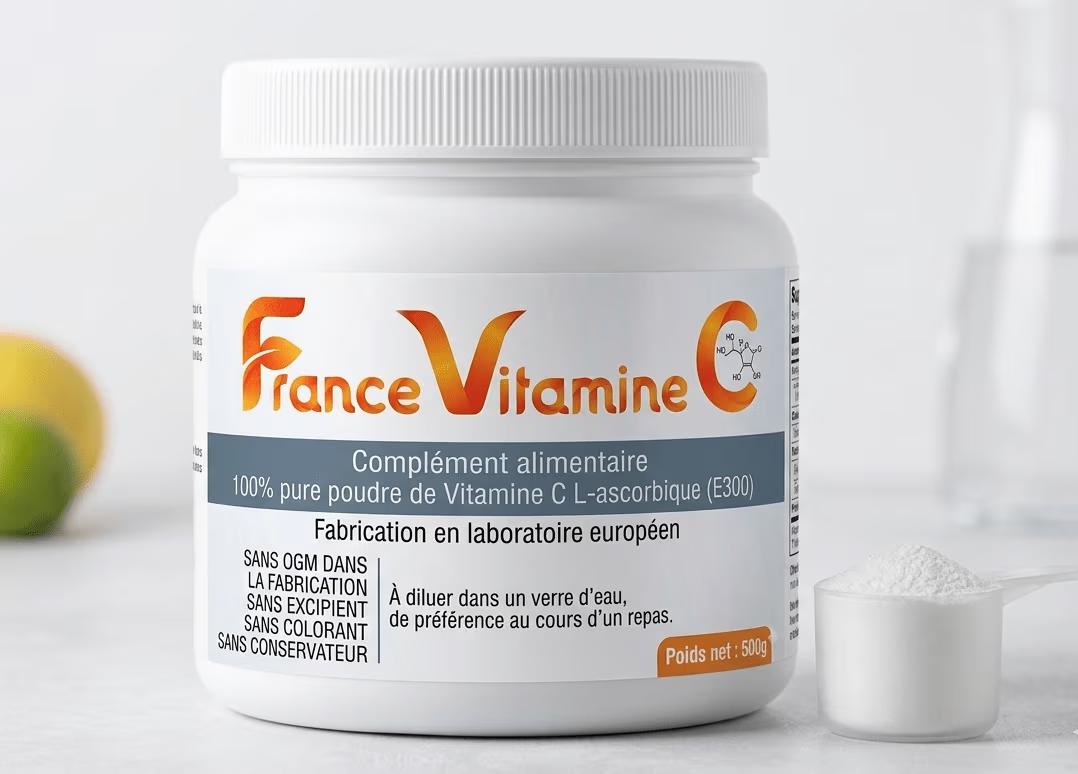
At France Vitamine C, we use L-ascorbic acid manufactured in the United Kingdom (Scotland) by dsm-firmenich, compliant with the European Pharmacopoeia (Ph. Eur.), non-GMO, with direct traceability and a certificate of analysis available for every batch sold. To be clear: the United Kingdom is not part of the European Union, so our vitamin C is not manufactured in the EU. This choice has a cost, which we accept so that we can document what we write on our labels.
The origin of your vitamin C is not a logistical detail. It determines what you put in your body every day.