Liposomal technology
Absorption · Tolerance · Evidence · Limits
Liposomal vitamin C is presented as the "most absorbed" form. Marketing promise or scientific reality? The technology is serious, but it has its strengths and its limits. Here is an honest progress report, backed by studies.
What is liposomal vitamin C?
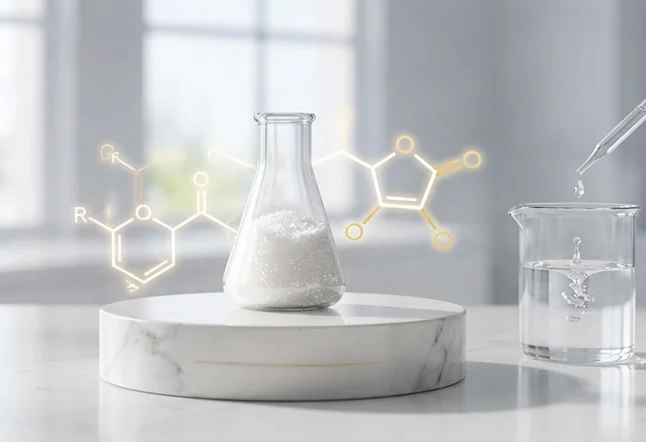
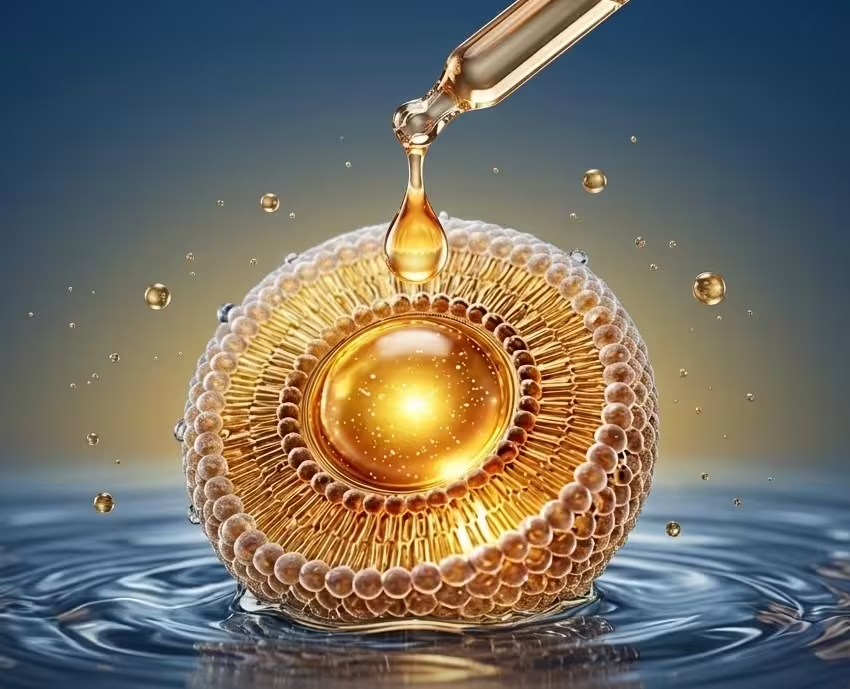
Vitamin C enclosed in a liposome, a tiny vesicle made of a phospholipid bilayer, the same type of molecule as our cell membranes. The shell aims to protect ascorbic acid in the stomach and ease its passage into the body.
A liposome is a tiny spherical vesicle formed of a double layer of phospholipids — exactly the type of molecules that make up our cell membranes. In a liposomal vitamin C, L-ascorbic acid is enclosed at the heart of this protective "bubble".
The idea is twofold: to protect vitamin C from degradation in the stomach, and to ease its passage into the body thanks to the natural affinity of phospholipids for membranes. The phospholipids used (often phosphatidylcholine derived from sunflower lecithin) also provide choline.
Why does high-dose oral vitamin C absorb poorly?
Because the intestinal SVCT1 transporters saturate. Levine et al. (1996, PNAS) showed the absorbed fraction falls markedly above 200 mg per dose, dropping below 50% at 1,250 mg.
The absorption of conventional vitamin C is not unlimited. It depends on intestinal transporters, the SVCT1, which become saturated. The landmark work of Levine et al. (1996, PNAS) showed that the absorbed fraction decreases markedly beyond 200 mg per dose: at 1,250 mg, bioavailability drops below 50%.
In other words, swallowing a very large dose of conventional vitamin C does not raise blood levels proportionally — part of it is simply eliminated. The liposomal route aims to bypass this limit by taking a different mode of absorption.
📚 Reference: Levine M, et al. Vitamin C pharmacokinetics in healthy volunteers. PNAS. 1996;93(8):3704-3709.
What advantages does the liposomal form offer?
Three: higher plasma concentrations at high doses than non-encapsulated vitamin C, better digestive tolerance because encapsulation limits the osmotic effect, and a more gradual release over time.
- Increased bioavailability at high doses: by protecting vitamin C and facilitating its absorption, the liposomal form makes it possible to reach higher plasma concentrations than non-encapsulated vitamin C.
- Better digestive tolerance: at high doses, conventional vitamin C can cause intestinal discomfort (osmotic effect). Encapsulation tends to reduce this drawback.
- More gradual release: the release can be more spread out over time, which maintains a more stable blood level.
What do studies on liposomal vitamin C show?
Davis et al. (2016) measured higher plasma concentrations than non-encapsulated vitamin C, though still lower than intravenous infusion. Łukawski et al. (2020) confirmed better bioavailability with a well-designed formulation.
The most cited study is that of Davis et al. (2016, Nutrition and Metabolic Insights). In volunteers, liposomal vitamin C produced higher plasma concentrations than non-encapsulated vitamin C, while remaining lower than intravenous infusion. More recently, Łukawski et al. (2020, Journal of Liposome Research) confirmed improved bioavailability with a well-designed liposomal formulation.
| Form | Plasma concentration reached |
|---|---|
| Conventional oral vitamin C | Limited by transporter saturation |
| Liposomal vitamin C | Higher than conventional oral |
| Intravenous vitamin C | The highest (medical use) |
The picture is encouraging, but it is important to stay measured: these studies involve small numbers of participants and remain few. The liposomal form sits "between" the conventional oral and intravenous routes, without matching the latter.
📚 Reference: Davis JL, et al. Liposomal-encapsulated Ascorbic Acid: Influence on Vitamin C Bioavailability. Nutr Metab Insights. 2016;9:25-30.
What are the limits of liposomal vitamin C?
Quality varies enormously: many products labelled liposomal contain no genuine liposomes, so the result depends entirely on manufacturing. Cost per gram is markedly higher, and large-scale trials are still missing.
- Highly variable quality: this is the key point. Many products labelled "liposomal" contain no genuine liposomes (incomplete or non-existent encapsulation). Effectiveness depends entirely on manufacturing quality.
- Higher cost: the process is more complex, so the price per gram of vitamin C is markedly higher than that of a pure powder.
- Still limited evidence: large-scale trials are lacking to quantify the clinical benefit precisely.
- Unnecessary at low doses: below 200 mg, conventional vitamin C is already well absorbed. The liposomal advantage shows mainly at high doses.
Who is liposomal vitamin C actually for?
People aiming at high intakes (1,000 mg or more) with optimised absorption, those who tolerate ordinary vitamin C poorly, and those who want maximum plasma levels orally. For moderate daily use, pure powder is cheaper.
Liposomal vitamin C makes sense for:
- People seeking high intakes (≥ 1,000 mg) with optimised absorption.
- Those who tolerate conventional vitamin C poorly from a digestive standpoint.
- Those who want to maximise plasma levels by the oral route, without resorting to intravenous administration.
For daily use at a moderate dose, a pharmaceutical-grade pure vitamin C remains an excellent and more economical choice.
How do you tell a genuine liposomal product?
Check four points before buying: real phospholipids (phosphatidylcholine, sunflower lecithin), the actual vitamin C dose per serving, stated origin and traceability, and no superfluous additives. A serious maker supplies a CoA.
Before buying, check: the presence of genuine phospholipids (phosphatidylcholine, sunflower lecithin), the actual dose of vitamin C per serving, the origin and traceability, and the absence of superfluous additives. A serious manufacturer states the source of the phospholipids and provides a certificate of analysis on request.
What Does a Gram of Liposomal Vitamin C Really Cost?
Roughly three to five times the price of the standard powder, vitamin C for vitamin C. The calculation is worth doing before you buy, because labels state powder weights, not amounts of vitamin C.
| Product | Size | Price | Indicative cost per gram of vitamin C |
|---|---|---|---|
| Pure L-ascorbic acid | 1 kg — €69.00 | €69.00 | ≈ €0.07 |
| Pure L-ascorbic acid | 500 g — €39.00 | €39.00 | ≈ €0.08 |
| Liposomal vitamin C | 500 g — €129.00 | €129.00 | several times higher |
There is a reason for the premium: encapsulation is a genuine industrial process, not a marketing line. The question is not whether it is justified for the manufacturer, but whether it is for you, given the strength of the evidence.
FAQ
Sources: Davis JL et al. (2016). Liposomal-encapsulated Ascorbic Acid. Nutr Metab Insights. | Levine M et al. (1996). Vitamin C pharmacokinetics in healthy volunteers. PNAS. | Łukawski M et al. (2020). New oral liposomal vitamin C formulation. J Liposome Res. | Padayatty SJ et al. (2004). Ann Intern Med. | EFSA (2013).