A Certificate of Analysis (CoA) is the document that accompanies each batch of pharmaceutical raw material. It's the analytical identity card of your vitamin C.
What is a certificate of analysis (CoA)?
A CoA is the official technical document, issued by the manufacturer or an independent laboratory, certifying that a batch meets European Pharmacopoeia (Ph. Eur.) specifications. It is a pharma standard, not a marketing sheet.
A CoA is an official document issued by the manufacturer or an independent laboratory certifying compliance with European Pharmacopoeia (Ph. Eur.) specifications.
It's not a marketing document. It's a standardized technical document used in pharma for decades.
Which sections of a CoA should you read first?
Read four blocks: the batch identification header, the assay (Ph. Eur. requires at least 99.0% L-ascorbic acid, pharmaceutical grade shows 99.7% or more), heavy metals under ICH Q3D, and the microbiological results.
1. Batch Identification
Header contains: product name, batch number, manufacturing date, expiration date, manufacturer name, monograph reference.
2. Purity Test (Assay)
Ph. Eur. requires minimum 99.0% L-ascorbic acid. Quality pharmaceutical grade shows 99.7% or higher.
3. Heavy Metals and Elemental Impurities
Regulatory limits per ICH Q3D and Ph. Eur.:
| Element | Ph. Eur. Limit | Expected result (good CoA) |
|---|---|---|
| Lead (Pb) | <0,5 ppm | <0,1 ppm |
| Arsenic (As) | <0,3 ppm | <0,1 ppm |
| Mercury (Hg) | <0,1 ppm | Not detected |
| Cadmium (Cd) | <0,5 ppm | <0,1 ppm |
4. Microbiological Tests
TAMC <1000 CFU/g, TYMC <100 CFU/g, absence of E. coli and Salmonella.
5. Physico-chemical Tests
Appearance, pH, specific optical rotation, loss on drying (<0.4%), sulfated ash (<0.1%).
What are the red flags on a vitamin C CoA?
Walk away from a document with no batch number, no date or issuing laboratory, a purity below 99.0%, a reference to an internal standard instead of Ph. Eur. or USP, or heavy metal results with no figures.
What should alert you on a CoA:
- No batch number — the document is generic
- Reference to internal standard instead of Ph. Eur. or USP
- Purity below 99.0%
- No heavy metals tests or compliant without numerical value
- Undated document or unidentified issuing laboratory
- Missing microbiological results
How do you get the CoA for your own batch?
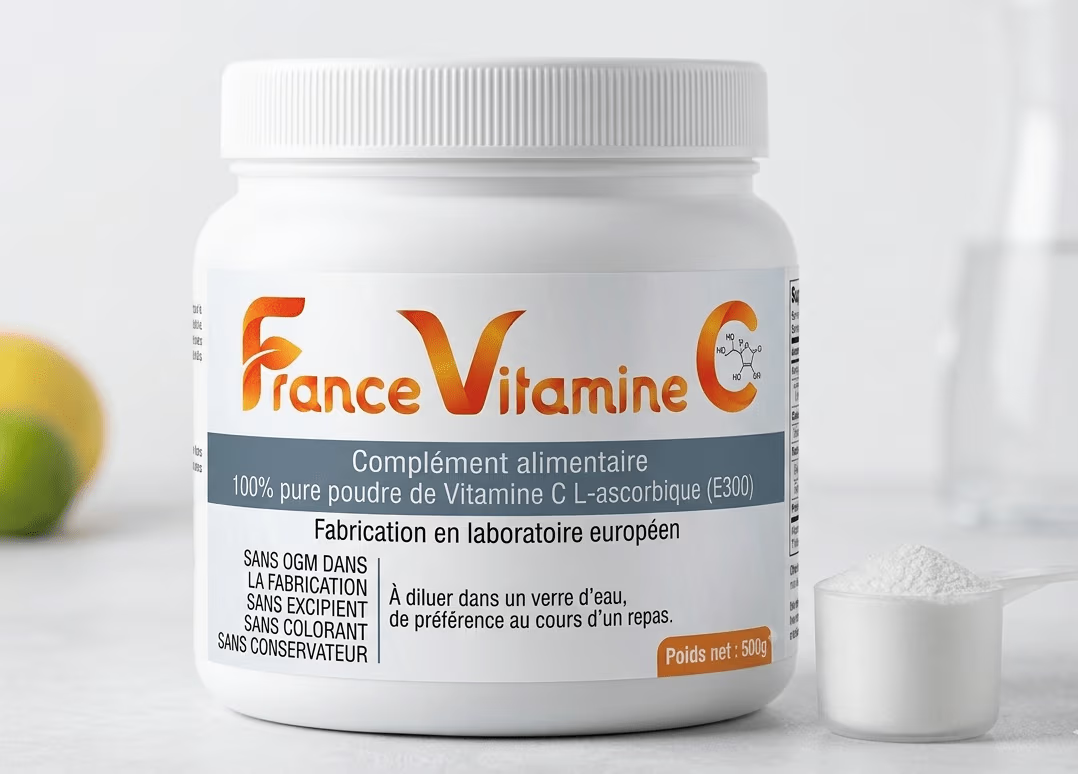
Ask the seller, with your order number: at France Vitamine C the CoA for your batch is sent on simple request. A seller who refuses to hand over that document probably has little to show.
At France Vitamine C, the CoA is available upon simple request with your order number.
A seller who refuses to provide their batch's certificate of analysis probably has nothing good to show.
How do you tell a solid certificate of analysis from a dubious one?
Line by line. A solid certificate gives a numerical value and a normative reference for every test. A dubious certificate offers only general statements, leaves out dates, or says "compliant" without a single figure.
| Certificate line | What a solid certificate shows | What should raise a flag |
|---|---|---|
| Batch number | Present, unique, identical to the one on the label | Missing, or a document that is plainly generic |
| Reference monograph | Ph. Eur. or USP, with the monograph number | "In-house standard", or no reference cited |
| Assay (purity) | From 99.0% to 100.5%, often 99.7% and above | A value below 99.0%, or no value at all |
| Heavy metals | A figure for each element: Pb, As, Hg, Cd | Only the word "compliant", with no figure |
| Microbiology | TAMC, TYMC, E. coli and Salmonella, with figures | Section missing from the document |
| Dates | Manufacturing date and expiry date | Undated document |
| Issuer | Named laboratory or manufacturer, with a signatory | No signatory, or just a logo |
Why does the certificate of analysis matter?
The CoA is the only objective document that proves a supplement's quality. France Vitamine C provides it on request and cites PubMed publications, ANSES and EFSA recommendations and the European Pharmacopoeia as its sources.
The certificate of analysis is the only objective document proving a supplement's quality.